
Market Overview:
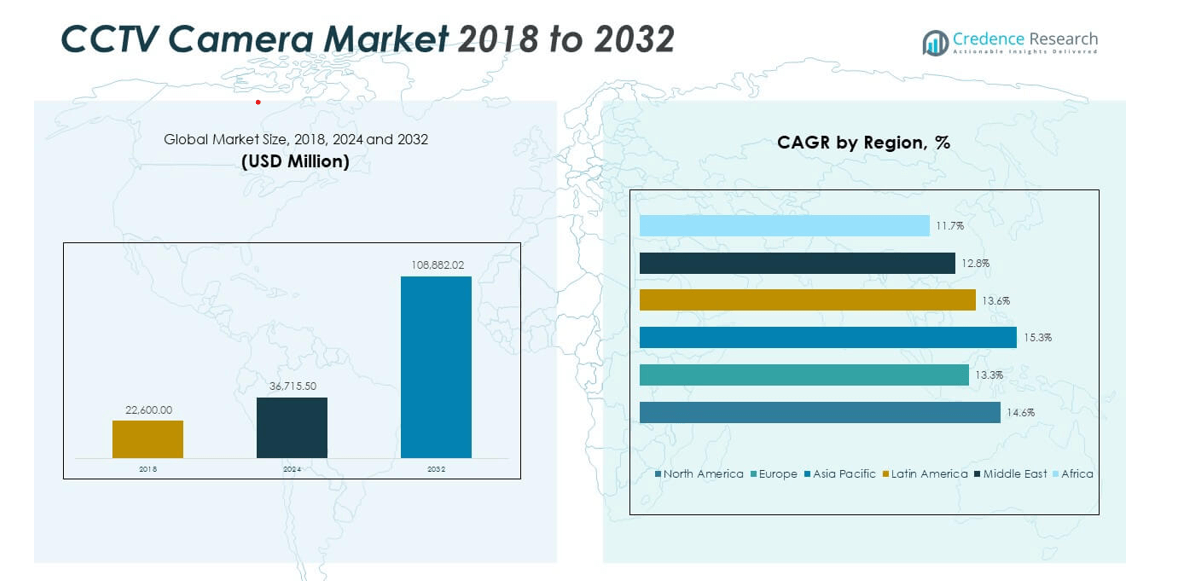
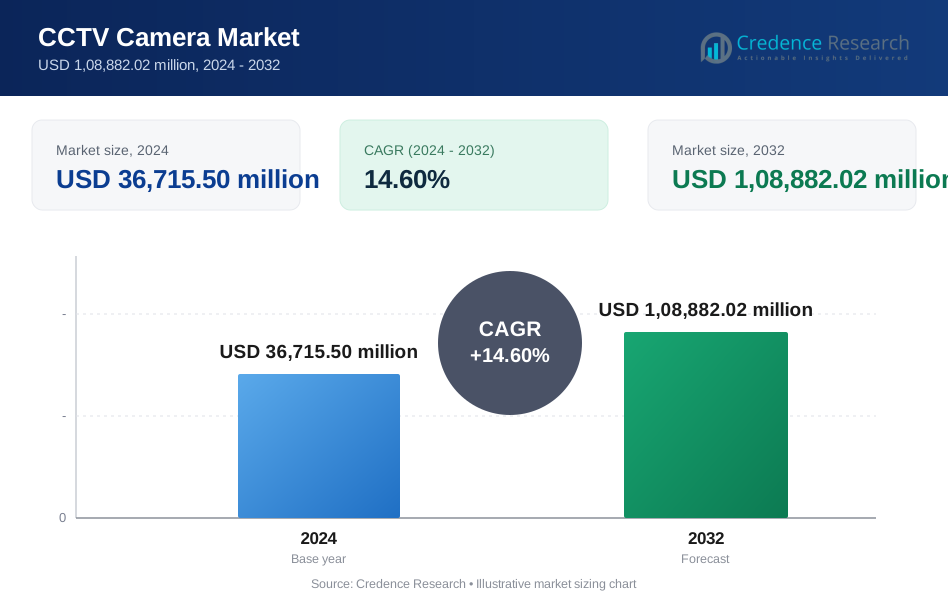
The CCTV Camera Market size was valued at USD 22,600.00 million in 2018 to USD 36,715.50 million in 2024 and is anticipated to reach USD 1,08,882.02 million by 2032, at a CAGR of 14.60% during the forecast period.
| REPORT ATTRIBUTE | DETAILS |
|---|---|
| Historical Period | 2020-2023 |
| Base Year | 2024 |
| Forecast Period | 2025-2032 |
| CCTV Camera Market Size 2024 | USD 36,715.50 million |
| CCTV Camera Market, CAGR | 14.60% |
| CCTV Camera Market Size 2032 | USD 1,08,882.02 million |
The market is expanding due to rising security needs across public, commercial, and residential sectors. Governments and private entities are investing in surveillance infrastructure to enhance public safety and asset protection. AI-powered analytics, facial recognition, and cloud integration are increasing system capabilities. Smart city initiatives, real-time monitoring demands, and stronger regulatory frameworks are further accelerating adoption. Technological advancements in connectivity and storage are supporting scalable deployments.
Asia Pacific leads the market, supported by rapid urbanization, smart city development, and strong manufacturing capabilities. North America shows strong growth driven by technological innovation and infrastructure investments. Europe maintains steady demand backed by regulatory compliance and security modernization. Latin America, the Middle East, and Africa are emerging regions, supported by growing security needs and expanding urban development.
Market Insights:
- The CCTV Camera Market size was valued at USD 22,600.00 million in 2018, USD 36,715.50 million in 2024, and is projected to reach USD 1,08,882.02 million by 2032, growing at a CAGR of 14.60%.
- Asia Pacific holds the largest regional share at 49.7%, supported by rapid urbanization, infrastructure growth, and smart city programs. North America follows with 16.2%, driven by advanced surveillance adoption and strong regulatory frameworks, while Europe holds 13.2%, supported by modernization and compliance standards.
- Asia Pacific remains the fastest-growing region, driven by government surveillance projects, cost-effective manufacturing, and increasing demand from transportation and commercial sectors.
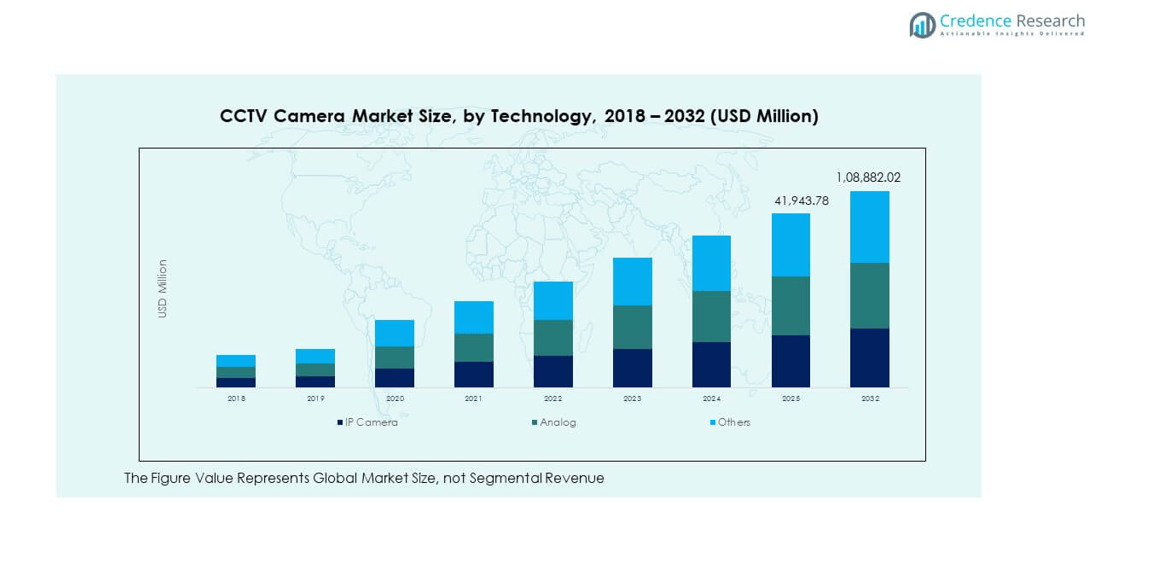
- IP Cameras account for 36.5% of the market share, reflecting their strong adoption for high-quality imaging and scalability.
- Analog Cameras hold 33.4%, while Others (including wireless) represent 30.1%, supported by their flexibility, cost benefits, and growing use in residential and SME applications.
Market Drivers
Rising Demand for Advanced Surveillance Solutions Across Public and Private Infrastructure
Urbanization and security concerns are driving large-scale surveillance deployments. Governments and enterprises are installing high-resolution cameras to monitor public spaces, transportation hubs, and critical facilities. The need for real-time threat detection is growing. It supports law enforcement in identifying criminal activity and improving emergency response. Integration with access control and alarm systems strengthens security networks. Retailers, industries, and residential owners are adopting advanced solutions for property protection. Cloud-based monitoring simplifies remote surveillance. These factors are pushing the adoption of intelligent surveillance systems at scale.
- For instance, in September 2025, Bosch Video Systems unveiled its AI-enabled video analytics at GSX 2025, featuring thermal cameras like the DINION Thermal 8100i, capable of detecting camouflaged intruders from distances up to 1,923 feet, alongside hybrid Intelligent Video Analytics Pro software that interprets complex scenes in real time, enhancing perimeter and public security applications.
Growing Adoption of AI-Powered Video Analytics and Automation Features
AI and machine learning technologies are transforming traditional security systems into intelligent networks. Real-time analytics can identify suspicious behavior, reducing dependence on manual monitoring. Automation enables faster alerts, increasing operational efficiency. It enhances situational awareness across critical environments like airports, hospitals, and government facilities. Businesses benefit from improved asset protection and reduced response time. The demand for smart surveillance grows with rising cybersecurity measures. AI enhances camera performance with facial and object recognition. This trend strengthens the overall value of surveillance investments.
Expanding Smart City Initiatives Driving Large-Scale Infrastructure Deployment
Smart city programs are boosting investments in advanced surveillance infrastructure. Municipalities deploy connected cameras for traffic management, crowd monitoring, and disaster response. Real-time feeds support quick decision-making. It creates integrated city command centers with automated data processing. Continuous expansion of urban areas fuels new security requirements. High-resolution cameras are enabling efficient surveillance coverage. Smart city strategies also include facial recognition systems for identity verification. These factors make surveillance technology a core pillar of urban safety initiatives.
Rising Crime Rates and Growing Need for Proactive Security Measures
Security threats and crime rates are pushing organizations to adopt robust surveillance solutions. Businesses invest in high-definition cameras to safeguard assets and personnel. Law enforcement agencies use footage to solve cases efficiently. It enhances public confidence through visible security measures. Industries with sensitive operations prefer 24/7 monitoring. Improved recording quality allows detailed evidence collection. Security firms are integrating analytics for predictive threat detection. These developments are supporting faster growth in the CCTV Camera Market across multiple sectors.
- For instance, Honeywell Building Technologies’ Pro-Watch Integrated Security Suite 5.5 combines video surveillance, access control, and intrusion management within a unified platform. It supports TLS 1.2 encryption and bulk firmware upgrades, enhancing operational security and centralized monitoring.
Market Trends
Integration of AI and Edge Computing for Real-Time Decision-Making
Edge computing is enabling rapid processing of surveillance data near the source. Smart cameras analyze footage locally, reducing network load and latency. AI algorithms improve accuracy in motion detection and behavioral analytics. It helps in real-time threat response without relying solely on cloud systems. Governments and enterprises are upgrading legacy systems. The shift enhances scalability and operational resilience. Integration with other security platforms improves coordination. This trend supports the shift toward smarter, decentralized surveillance networks.
Increased Adoption of Wireless and Cloud-Connected Surveillance Solutions
Cloud adoption is transforming the way surveillance infrastructure operates. Wireless connectivity enables flexible camera placement with minimal cabling. Remote access features allow users to monitor multiple sites from centralized dashboards. It enhances scalability and reduces maintenance costs. Businesses prefer cloud-based solutions for data storage and real-time streaming. Continuous software updates strengthen system security. Integration with mobile platforms makes monitoring more user-friendly. This trend accelerates the modernization of surveillance ecosystems worldwide.
Growing Use of Facial Recognition and Biometric Surveillance Applications
Facial recognition is becoming a core feature in security systems. Governments deploy biometric solutions for border control, traffic management, and law enforcement. Private organizations use them for access control and identity verification. It improves accuracy in tracking individuals across environments. The technology supports predictive analytics, enhancing incident prevention. Retailers use recognition to analyze customer behavior. Transportation hubs rely on it to improve passenger flow and safety. This trend is reshaping security strategies at multiple levels.
- For instance, in June 2025, Sony launched its Camera Verify feature for the Alpha 7 IV, embedding cryptographic signatures at the moment of capture. This technology helps verify image authenticity and detect any tampering, supporting secure digital content workflows for sensitive applications.
Rising Focus on Cybersecurity and Data Protection in Surveillance Networks
Cybersecurity concerns are shaping how modern surveillance systems are designed. Connected cameras require secure protocols to protect sensitive footage. Manufacturers are implementing end-to-end encryption and authentication layers. It reduces risks of unauthorized access and data breaches. Governments are setting strict compliance standards. Enterprises are investing in security audits to strengthen resilience. Advanced firmware protections ensure stable system performance. This trend drives innovation in secure surveillance architecture.
- For instance, Axis’ Edge Vault hardware security module provides secure key storage, signed OS, and secure boot validation. This technology protects device integrity and safeguards surveillance networks against unauthorized firmware or tampering.
Market Challenges Analysis
High Installation and Maintenance Costs Limiting Adoption in Cost-Sensitive Markets
The cost of deploying high-resolution surveillance systems remains a major barrier for small enterprises and municipalities. Installation involves complex cabling, server integration, and power infrastructure. Maintenance requires skilled personnel and regular upgrades. It raises total ownership costs for end-users with limited budgets. Many organizations delay modernization due to high initial investments. Price sensitivity affects large-scale adoption in developing regions. Budget constraints also limit integration with advanced analytics. These challenges slow penetration in cost-sensitive segments, despite growing security concerns.
Data Privacy Regulations and Cybersecurity Risks Affecting Market Expansion
Rising privacy regulations are imposing stricter guidelines on surveillance operations. Governments demand transparent data collection and usage practices. Organizations must comply with evolving legal frameworks. It increases the operational burden for businesses deploying connected surveillance networks. Cybersecurity threats such as data breaches and ransomware attacks create additional risks. Manufacturers must upgrade software security and encryption standards. Non-compliance leads to legal liabilities and reputational damage. These challenges create a complex environment for sustainable growth in the CCTV Camera Market.
Market Opportunities
Expansion of AI-Driven Analytics Creating New Commercial and Government Applications
AI-powered analytics present significant growth opportunities in surveillance networks. Predictive monitoring enhances security across critical infrastructure. Governments can use intelligent systems to automate emergency response. It supports industries like healthcare, logistics, and retail in improving safety operations. Smart alerting reduces manpower dependency. Integration with city infrastructure increases operational efficiency. New software solutions create opportunities for service providers. These advancements open scalable and profitable market segments.
Rapid Urbanization and Emerging Market Investments Supporting Industry Growth
Developing countries are increasing investments in surveillance networks to strengthen urban security. Expanding cities require intelligent monitoring systems for transportation, utilities, and housing. It supports infrastructure modernization efforts. Global firms are entering these markets with cost-effective, scalable solutions. Regional governments are launching smart city projects. Advancements in connectivity improve deployment feasibility. This environment creates strong commercial potential for vendors. These opportunities strengthen the global position of the CCTV Camera Market.
Market Segmentation Analysis:
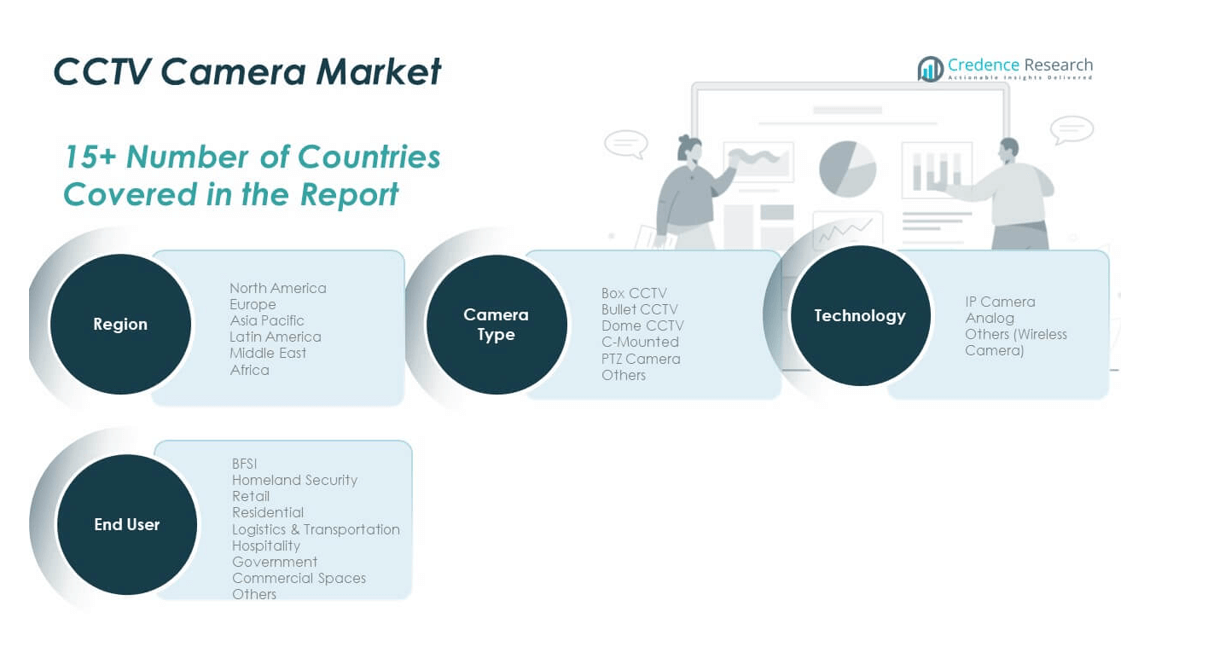
The CCTV Camera Market is segmented into camera type, technology, and end-user categories.
By camera type, bullet CCTV and dome CCTV dominate due to their wide use in commercial, government, and residential spaces. Bullet cameras offer long-range coverage and clear visibility, making them suitable for outdoor surveillance. Dome cameras are preferred for discreet indoor monitoring. PTZ cameras provide flexible movement and high coverage for critical security zones. Box CCTV and C-Mounted CCTV serve niche requirements in industrial and commercial environments. Infrared cameras support low-light and night-time surveillance, expanding their adoption across sensitive facilities.
- For instance, Sony’s official BRC-X400 4K PTZ camera employs a 1/2.5-type Exmor R CMOS sensor, capable of 30x optical zoom in 4K and up to 80x in Full HD, complemented by a 70° wide viewing angle and IP-based video transmission via NDI|HX, RTSP, and SRT protocols.
By technology, IP cameras lead the segment due to advanced image quality, remote monitoring features, and easier system integration. It offers scalable solutions for modern surveillance infrastructure. Analog cameras continue to serve cost-sensitive users, particularly in small-scale installations. Wireless cameras are gaining popularity for flexible deployment and reduced cabling requirements in remote or temporary sites.
- For instance, Axis Communications’ P1467-LE bullet IP camera features a 5 MP CMOS sensor paired with Lightfinder 2.0 technology, capturing full-color footage at 0.13 lux in low light and zero-lux capability using OptimizedIR with an illumination range up to 40 meters. It is built on Axis ARTPEC-8 SoC for deep learning-based analytics.
By end-user, government and homeland security hold a major share due to strong investments in public safety infrastructure. Retail and logistics deploy surveillance to protect assets and monitor operational flow. BFSI uses advanced security to safeguard sensitive financial environments. Hospitality applications focus on guest safety and operational visibility. Other sectors, including education and healthcare, are expanding surveillance networks to strengthen risk management and security compliance.
Segmentation:
By Camera Type
- Box CCTV
- Bullet CCTV
- Dome CCTV
- C-Mounted CCTV
- PTZ Camera
- Others (Infrared Camera)
By Technology
- IP Camera
- Analog Camera
- Others (Wireless Camera)
By End-User
- BFSI
- Homeland Security
- Retail
- Logistics & Transportation
- Hospitality
- Government
- Others
By Region
- North America
- U.S.
- Canada
- Europe
- Germany
- France
- Italy
- U.K.
- Russia
- Rest of Europe
- Asia-Pacific
- India
- China
- Japan
- Rest of Asia-Pacific
- Latin America
- Brazil
- Mexico
- Rest of Latin America
- Middle East and Africa
- GCC Countries
- South Africa
- Rest of Middle East and Africa
Regional Analysis:
North America
The North America CCTV Camera Market size was valued at USD 4,226.20 million in 2018 to USD 6,704.03 million in 2024 and is anticipated to reach USD 19,827.61 million by 2032, at a CAGR of 14.6% during the forecast period. North America holds a 16.2% market share. Strong investments in security infrastructure and smart city initiatives are strengthening surveillance deployments. The region leads in adopting AI-enabled and cloud-integrated camera systems. It benefits from a mature technology ecosystem and high public safety standards. Government agencies and private enterprises deploy advanced surveillance to secure critical assets. Rising security threats across commercial and public facilities are increasing demand. Integration with access control and IoT platforms enhances monitoring efficiency. High consumer spending and regulatory mandates further boost regional growth.
Europe
The Europe CCTV Camera Market size was valued at USD 3,909.80 million in 2018 to USD 5,976.28 million in 2024 and is anticipated to reach USD 16,196.49 million by 2032, at a CAGR of 13.3% during the forecast period. Europe holds a 13.2% market share. The region shows steady growth driven by strong regulatory compliance frameworks. Governments enforce strict data security and surveillance standards. It supports large-scale adoption of IP and AI-based systems. Transportation, banking, and government sectors deploy intelligent monitoring for risk management. Urban modernization programs enhance camera deployments across cities. Strong infrastructure, public safety measures, and tech innovation continue to support the market. Strategic investments by private enterprises increase system sophistication.
Asia Pacific
The Asia Pacific CCTV Camera Market size was valued at USD 11,819.80 million in 2018 to USD 19,600.41 million in 2024 and is anticipated to reach USD 61,006.68 million by 2032, at a CAGR of 15.3% during the forecast period. Asia Pacific holds a 49.7% market share. Rapid urbanization, strong infrastructure growth, and government-backed surveillance initiatives drive market expansion. The region leads in smart city deployments and mass surveillance projects. It benefits from cost-effective manufacturing and wide technology adoption. High demand from transportation, logistics, and public safety sectors boosts installations. Evolving cybersecurity standards strengthen system integration. Strong adoption in China, India, Japan, and South Korea contributes to dominant regional growth. Ongoing infrastructure investments enhance long-term market opportunities.
Latin America
The Latin America CCTV Camera Market size was valued at USD 1,514.20 million in 2018 to USD 2,437.54 million in 2024 and is anticipated to reach USD 6,736.53 million by 2032, at a CAGR of 13.6% during the forecast period. Latin America holds a 5.5% market share. Rising crime rates and growing infrastructure development are key market drivers. Governments focus on improving city surveillance systems and border security. It experiences rising adoption of cost-effective analog and IP cameras. Private businesses invest in advanced monitoring for asset protection. Urban expansion and industrialization support long-term demand. Cloud-based solutions and wireless deployments gain traction across mid-sized cities. Strategic collaborations between public and private sectors enhance security capabilities.
Middle East
The Middle East CCTV Camera Market size was valued at USD 700.60 million in 2018 to USD 1,049.82 million in 2024 and is anticipated to reach USD 2,733.54 million by 2032, at a CAGR of 12.8% during the forecast period. The Middle East holds a 2.2% market share. Large-scale infrastructure projects and critical facility protection drive demand. Governments are adopting smart surveillance solutions for urban safety. It benefits from strong investments in public security systems. Integration with facial recognition and IoT platforms enhances situational awareness. High-end PTZ and dome cameras are used across airports, malls, and public buildings. Oil and gas industries strengthen security networks with AI-driven systems. Expanding connectivity and modernization create strong market potential.
Africa
The Africa CCTV Camera Market size was valued at USD 429.40 million in 2018 to USD 947.41 million in 2024 and is anticipated to reach USD 2,381.17 million by 2032, at a CAGR of 11.7% during the forecast period. Africa holds a 1.9% market share. Security concerns and infrastructure upgrades are increasing adoption of surveillance systems. Governments are deploying public safety monitoring across transport hubs and city centers. It is experiencing rising demand for cost-efficient analog and wireless solutions. Urban growth and economic development create new investment opportunities. Commercial establishments adopt cameras for risk management and theft prevention. Limited connectivity and budget constraints remain challenges. Ongoing smart city initiatives will support steady market expansion across key economies.
Key Player Analysis:
- Bosch Security Systems Inc. (U.S.)
- Honeywell Security Group (U.S.)
- Hangzhou Hikvision Digital Technology Co., Ltd. (China)
- Axis Communications AB (Sweden)
- Mobotix AG (Germany)
- Zhejiang Dahua Technology Co., Ltd. (China)
- Panasonic System Networks Co., Ltd. (Japan)
- Geovision Inc. (Germany)
- Sony Electronics Ltd. (Japan)
- FLIR Systems Inc. (U.S.)
Competitive Analysis:
The CCTV Camera Market is characterized by strong competition among global and regional players. It features established brands with extensive product portfolios and emerging firms offering cost-effective solutions. Companies focus on AI integration, edge computing, and cloud connectivity to strengthen their offerings. Hikvision, Dahua Technology, Bosch, Honeywell, Axis Communications, Panasonic, Sony, FLIR Systems, Geovision, and Mobotix dominate the competitive landscape. These players invest in R&D to enhance camera performance, cybersecurity, and interoperability. Strategic collaborations and acquisitions expand their geographic reach and market presence. Firms target smart city projects, government surveillance programs, and enterprise security deployments. Product differentiation through advanced analytics and scalable platforms remains a key competitive strategy.
Recent Developments:
- In October 2025, Hangzhou Hikvision Digital Technology Co., Ltd. formed a new partnership with InfraX, a subsidiary of Digital DEWA in the UAE. The collaboration, formalized through a Memorandum of Understanding, aims to co-develop innovative AI and machine learning-driven video analytics solutions.
- In October 2025, Wyzeannounced the launch of its new Solar Cam Pan on October 20, 2025. This solar-powered security camera offers full 360-degree coverage and AI-driven intruder tracking, launching at a competitive price of around $80. It is designed for outdoor use and includes pan-tilt motion, person detection, and continuous solar charging, giving users long-term surveillance power without frequent recharging needs.
- In September 2025, Axis Communications AB unveiled its latest generation of surveillance technology at the Global Security Exchange (GSX) in New Orleans. The new lineup includes the AXIS Q6411-LE Bispectral PTZ camera, combining thermal and visual sensors, AI-powered bullet cameras, as well as radars and air-quality sensors for multi-sensory environmental monitoring.
- In June 2025, Bosch Security Systems Inc. underwent a major structural change as its security and communications technology product business was acquired by Triton Partners. The transaction, which was finalized in late June, resulted in the formation of a new entity named Keenfinity Group.
- In June 2025, Honeywell Security Group announced the launch of its first-ever CCTV camera portfolio designed and manufactured entirely in India, known as the 50 Series. Developed in collaboration with VVDN Technologies, the line supports the Indian government’s Atmanirbhar Bharat initiative. These locally engineered cameras are Class 1 certified, featuring enhanced cybersecurity, gyro-based image stabilization, and advanced analytics.
Report Coverage:
The research report offers an in-depth analysis based on Camera Type, Technology and End-User. It details leading market players, providing an overview of their business, product offerings, investments, revenue streams, and key applications. Additionally, the report includes insights into the competitive environment, SWOT analysis, current market trends, as well as the primary drivers and constraints. Furthermore, it discusses various factors that have driven market expansion in recent years. The report also explores market dynamics, regulatory scenarios, and technological advancements that are shaping the industry. It assesses the impact of external factors and global economic changes on market growth. Lastly, it provides strategic recommendations for new entrants and established companies to navigate the complexities of the market.
Future Outlook:
- Expanding integration of AI and edge computing will drive smarter surveillance applications across industries.
- Growth in smart city projects will create sustained demand for large-scale video monitoring networks.
- Rising emphasis on public safety and infrastructure protection will boost camera deployments in urban areas.
- Shifting preference toward IP and wireless solutions will accelerate digital transformation in surveillance systems.
- Demand for predictive analytics and facial recognition will strengthen advanced security infrastructure.
- Expanding government investments in critical infrastructure will support long-term market growth.
- Strategic partnerships between camera manufacturers and software providers will enhance ecosystem integration.
- Adoption of cloud storage and real-time monitoring will expand across commercial and residential sectors.
- Rising use of mobile surveillance solutions will increase flexibility in security operations.
- Continuous product innovation and cost optimization will intensify competition among leading players.
Request a Free Sample
Fill in your details and we'll send you a free sample report.
- Sample data tables & charts
- Research methodology
Need a Custom Version of This Report?
Tailor the scope, geography, or segments to your exact requirements.
- Custom geography or segment scope
- Direct access to our analyst team
Frequently Asked Questions
What is the current market size for CCTV Camera Market, and what is its projected size in 2032?
At what Compound Annual Growth Rate is the CCTV Camera Market projected to grow between 2024 and 2032?
Which CCTV Camera Market segment held the largest share in 2024?
What are the primary factors fueling the growth of the CCTV Camera Market?
Who are the leading companies in the CCTV Camera Market?
What are the key drivers for the growth of the CCTV Camera market?
Table of Content
Chapter 1. Report Introduction
- 1.1 Report Description & Purpose
- 1.1.1 Report Title & Market Definition
- 1.1.2 Unique Selling Propositions (USP) & Key Differentiators
- 1.1.3 Value Proposition for Stakeholders
- 1.2 Research Objectives
- 1.2.1 Market Sizing Objectives (Volume & Revenue)
- 1.2.2 Segmentation Objectives
- 1.2.3 Competitive Intelligence Objectives
- 1.2.4 Forecast & Scenario Objectives
- 1.3 Report Scope
- 1.3.1 CCTV Camera Scope – Types & Subtypes Covered
- 1.3.2 Geographic Scope – Regions & Countries Covered
- 1.3.3 Historical Period, Base Year & Forecast Period (2024; forecast to 2032)
- 1.3.4 Inclusions & Exclusions
- 1.4 HS Code & Classification Framework
- 1.5 Currency, Units & Pricing Basis
- 1.6 Target Stakeholders
- 1.7 Limitations & Assumptions
Chapter 2. Executive Summary
- 2.1 Global CCTV Camera Market Snapshot
- 2.1.1 Market Size – Historical (2024) & Forecast (2024-2032) (2024: USD 36,715.50 million → 2032: USD 1,08,882.02 million)
- 2.1.2 Volume & Revenue – Global Totals
- 2.1.3 Key Market Highlights – Top Five Facts
- 2.2 CCTV Camera Market Segmentation Snapshot
- 2.2.1 Market Split by Region – 2024 vs. 2032
- 2.3 Competitive Snapshot
- 2.3.1 Top 10 Players by Revenue Share – 2024
- 2.3.2 Top 10 Players by Volume Share – 2024
- 2.3.3 Recent Strategic Developments (18-Month Summary)
- 2.4 Key Investment Highlights & Strategic Conclusions
Chapter 3. CCTV Camera Market Dynamics & Industry Analysis
- 3.1 Market Overview & Context
- 3.1.1 CCTV Camera Market Position in the Broader Automotive Value Chain
- 3.1.2 OEM vs. Replacement Market Dynamics
- 3.1.3 Market Maturity & Development Stage by Region
- 3.2 CCTV Camera Market Drivers
- 3.3 CCTV Camera Market Restraints & Challenges
- 3.4 CCTV Camera Market Opportunities
- 3.5 Porter's Five Forces Analysis
- 3.5.1 Threat of New Entrants
- 3.5.2 Bargaining Power of Suppliers
- 3.5.3 Bargaining Power of Buyers
- 3.5.4 Threat of Substitutes
- 3.5.5 Competitive Rivalry – Intensity Assessment
- 3.6 CCTV Camera Value Chain Analysis
- 3.6.1 Upstream – Raw Material/Input Suppliers
- 3.6.1.1 Raw Material/Input 1
- 3.6.1.2 Raw Material/Input 2
- 3.6.1.3 Raw Material/Input 3
- 3.6.2 Midstream – Production/Manufacturing/Service Delivery
- 3.6.2.1 Production/Process Overview
- 3.6.2.2 Key Facility Locations & Capacity by Manufacturer
- 3.6.3 Downstream – Distribution & End Consumer
- 3.6.3.1 Primary Channel – B2B/OEM
- 3.6.3.2 Secondary Channels – Dealer, Retail, Online, Direct
- 3.6.4 Value Chain Profitability Analysis
- 3.6.1 Upstream – Raw Material/Input Suppliers
- 3.7 PESTEL Analysis
- 3.7.1 Political Factors
- 3.7.2 Economic Factors
- 3.7.3 Social Factors
- 3.7.4 Technological Factors
- 3.7.5 Environmental Factors
- 3.7.6 Legal Factors
- 3.8 CCTV Camera Supply Chain Analysis
- 3.8.1 Raw Material/Input Supply Risk Assessment
- 3.8.2 Manufacturing Concentration Risk (Geographic Exposure)
- 3.8.3 Trade Disruption Impact Analysis
- 3.9 Regulatory & Policy Landscape
Note: The regulatory and policy landscape section covers regulations based on their applicability to the market, CCTV Camera category, geography, and scope of the study. Only regulatory frameworks with a material impact on operations, compliance, trade, sustainability, or market access are analyzed in detail.
Chapter 4. Key Investment Pockets & Opportunity Analysis
- 4.1 CCTV Camera Market Attractiveness Analysis
- 4.1.1 By Region – Investment Attractiveness Matrix (Volume × CAGR)
- 4.2 Absolute Revenue Growth Opportunity
- 4.2.1 By Region – Absolute USD Growth Through 2032
- 4.3 Incremental Volume Opportunity
- 4.3.1 By Region – Incremental Volume Through 2032
- 4.3.2 Segment – Incremental Volume
- 4.4 Emerging Submarket Opportunity Deep Dive (Subject to Applicability)
- 4.5 Emerging Market Opportunity Scorecards
- 4.5.1 United States
- 4.5.2 Europe
- 4.5.3 Asia
- 4.5.4 Middle East & Africa
Note: Emerging Market Opportunity Scorecards will be included based on relevance and strategic importance. Regions listed are indicative and may vary depending on data availability and market dynamics.
Chapter 5. CCTV Camera Import-Export Analysis & Trade Flows
- 5.1 Global Trade Overview
- 5.1.1 Global Export Value by Country (2024)
- 5.1.2 Global Export Volume by Country (2024)
- 5.1.3 Global Import Value by Country (2024)
- 5.1.4 Global Import Volume by Country (2024)
- 5.1.5 Net Trade Balance by Country (2024)
- 5.2 Export Analysis – Segment
- 5.2.1 Type 1 (HS Code)
- 5.2.2 Type 2 (HS Code)
- 5.2.3 Type 3 (HS Code)
- 5.2.4 Type 4 (HS Code)
- 5.2.5 Type 5 (HS Code)
- 5.3 Import Analysis – Segment
- 5.3.1 Type 1 (HS Code)
- 5.3.2 Type 2 (HS Code)
- 5.3.3 Type 3 (HS Code)
- 5.3.4 Type 4 (HS Code)
- 5.3.5 Type 5 (HS Code)
- 5.4 Average Unit Trade Prices
- 5.4.1 Average Export Price – Segment & Country
- 5.4.2 Average Import Price – Segment & Source Country
- 5.4.3 Price Trends (2024)
- 5.5 Key Trade Route Analysis
- 5.5.1 Trade Route 1
- 5.5.2 Trade Route 2
- 5.5.3 Trade Route 3
- 5.5.4 Trade Route 4
- 5.5.5 Trade Route 5
- 5.6 Trade Policy Impact Assessment
- 5.6.1 US Anti-Dumping & Section 301 Tariffs
- 5.6.2 EU Customs Union Impact
- 5.6.3 Major Free Trade Agreements
- 5.6.4 USMCA Rules of Origin
Note: Trade policy analysis will be included only where relevant to the CCTV Camera market.
Chapter 6. Competitive Landscape & Company Benchmarking
- 6.1 CCTV Camera Market Concentration & Structure
- 6.1.1 Herfindahl-Hirschman Index (HHI) – vs. 2024
- 6.1.2 Tier 1, Tier 2 & Tier 3 Market Structure
- 6.1.3 Global, Regional & Local Player Dynamics
- 6.2 CCTV Camera Market Share Analysis – 2024
- 6.2.1 Global Revenue Share by Company
- 6.2.2 Global Volume Share by Company
- 6.2.3 Regional Revenue Share
- 6.2.4 Market Share Evolution ( vs. 2024)
- 6.2.5 OEM Segment Share by Company
- 6.2.6 Replacement Segment Share by Company
- 6.3 Production/Delivery Capacity & Facility Analysis
- 6.3.1 Global Installed Capacity
- 6.3.2 Capacity Utilization Rates
- 6.3.3 Production/Output Volume
- 6.3.4 Facility Locations & Capacity Map
- 6.3.5 Planned Capacity Additions
- 6.4 CCTV Camera Competitive Benchmarking Matrix
- 6.4.1 Revenue, Volume, CAGR & Profitability Comparison
- 6.4.2 Channel Revenue Mix
- 6.4.3 Geographic Revenue Exposure
- 6.4.4 R&D Intensity
- 6.4.5 Sustainability Maturity
- 6.5 Strategic Developments in CCTV Camera (Last 24 Months)
- 6.5.1 Mergers, Acquisitions & Divestments
- 6.5.2 New CCTV Camera Launches
- 6.5.3 Facility Expansions
- 6.5.4 Strategic Alliances, Joint Ventures & Partnerships
- 6.5.5 Distribution Expansion & Market Entry
- 6.5.6 Sustainability & ESG Initiatives
- 6.6 Competitive Strategy Mapping
- 6.6.1 Leader, Challenger, Follower & Niche Classification
- 6.6.2 Pricing Strategy Comparison
- 6.6.3 Channel Strategy Matrix
Note: Strategic developments are included based on their materiality and the availability of reliable information.
Chapter 7. Global CCTV Camera Market – By Distribution Channel
- 7.1 Segment Overview
- 7.1.1 Volume & Revenue Split by Channel (2024 & 2032)
- 7.1.2 Channel Mix Evolution (2024-2032)
Chapter 8. Regional Market Analysis – Global Overview
- 8.1 Global Regional Overview
- 8.1.1 Regional Volume Share
- 8.1.2 Regional Revenue Share
- 8.1.3 Regional Volume by Region
- 8.1.4 Regional Revenue by Region
- 8.1.5 Regional Forecast Through 2032
- 8.2 Cross-Regional Segment Analysis
- 8.2.1 By Distribution Channel
- 8.2.2 By Brand/Price Tier
Chapter 9. North America CCTV Camera Market
- 9.1 United States
- 9.2 Canada
- 9.3 Mexico
Chapter 10. Europe CCTV Camera Market
- 10.1 Germany
- 10.2 France
- 10.3 Italy
- 10.4 United Kingdom
- 10.5 Spain
- 10.6 Poland
- 10.7 Russia
- 10.8 Netherlands
- 10.9 Belgium
- 10.10 Sweden
- 10.11 Denmark
- 10.12 Norway
- 10.13 Rest of Europe
Chapter 11. Asia Pacific CCTV Camera Market
- 11.1 China
- 11.2 India
- 11.3 Japan
- 11.4 South Korea
- 11.5 Thailand
- 11.6 Indonesia
- 11.7 Vietnam
- 11.8 Malaysia
- 11.9 Australia
- 11.10 Rest of Asia Pacific
Chapter 12. Latin America CCTV Camera Market
- 12.1 Brazil
- 12.2 Argentina
- 12.3 Colombia
- 12.4 Chile
- 12.5 Rest of Latin America
Chapter 13. Middle East CCTV Camera Market
- 13.1 Saudi Arabia
- 13.2 United Arab Emirates
- 13.3 Turkey
- 13.4 Israel
- 13.5 Iran
- 13.6 Rest of the Middle East
Chapter 14. Africa CCTV Camera Market
- 14.1 South Africa
- 14.2 Egypt
- 14.3 Nigeria
- 14.4 Morocco
- 14.5 Rest of Africa
Chapter 15. CCTV Camera Company Profiles
- 15.1 [Company 01]
- 15.1.1 Company Overview
- 15.1.2 Key Management Personnel
- 15.1.3 Products & Services Portfolio
- 15.1.4 Financial Performance
- 15.1.5 Key Market Focus & Geographic Presence
- 15.1.6 Recent Developments & Strategic Initiatives
Note: The company profile list is preliminary and may change based on research findings, market developments, data availability, and client requirements.
Chapter 16. Appendices
- Appendix A – List of Abbreviations & Acronyms
- Appendix B – Industry Classification Code Reference – Full Series
- Appendix C – Production & Capacity Data Tables
- Appendix D – End-Use & Demand Base Tables
- Appendix E – Consumption & Replacement Rate Assumptions
- Appendix F – ASP Reference Tables
- Appendix G – Manufacturing & Facility Database
- Appendix H – Import-Export Data Tables
- Appendix I – Regulatory Summary Tables
- Appendix J – Primary Research Participant List (Anonymized)
- Appendix K – Primary Research Questionnaire Framework
- Appendix L – Data Sources & Bibliography
- Appendix M – Market Size Divergence & Source Comparison
Chapter 17. Research Methodology
- 17.1 Research Framework & Philosophy
- 17.2 Secondary Research – Sources, Hierarchy & Data Extraction
- 17.3 Data Modeling – Bottom-Up & Top-Down Market Sizing
- 17.4 Primary Research – Stakeholder Framework, LOI & Sample Sizes
- 17.5 Forecast Methodology – Regression, Scenario & Sensitivity Analysis
- 17.6 Quality Control – Four-Layer Validation Framework
- 17.7 Limitations & Standard Assumptions
- 17.8 Disclaimer
